Interview With Brian McRae Of Fenix Fire Entertainment, Developers Of Osiris: New Dawn
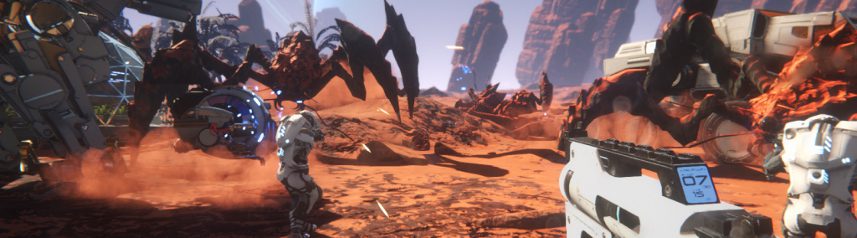
I recently had a chance to sit down with Fenix Fire Entertainment CEO and founder Brian McRae to discuss his company's Early Access survival game, Osiris: New Dawn. We discussed the game's inspirations, how many planets are planned, comparisons to No Man's Sky, and more.
So you’ve been working on Osiris on and off for five years?
Well, we had to do a lot of work-for hire projects to keep the company afloat. We’ve been indie since 2010. We’ve done a lot of projects for a lot of Fortune 500 companies and big brands—Red Bull, Chevron, John Deere, just to name a few, Tesla and so on, in addition to incubating our own IPs that we could get out to the market.
Our first game that we put out was a game called Roboto for the iOS and it went into the top 10 and did really well. From there, we got a lot of attention. Red Bull contacted us. A toy company called Wowee contacted us. We made a bunch of augmented reality titles with them and designed toys and robots, which is really cool. And then we’ve done a lot of motion simulator projects with John Deere and Chevron.
So that allowed us to grow the studio a little bit and incubate some passion projects that we really, really wanted to do. Of course, during that time, the market changed. The industry changed with the PlayStation 4 and the Xbox One. No longer were Sony and Microsoft going to be holding onto these coveted XBLA slots or digital download slots; they were going to open them up a lot more to indies. Traditionally, on the gen before that, the slots were only given to major publishers, so you had to work with a major publisher.
My old company, the company I had before this one, focused on cinematics, but, in there, we had a deal with a major publisher and they canceled the project on us because they were just horrible. This isn’t my first rodeo. I’ve been doing this for a long time.
How many people are working on the game currently?
So, right now, it’s just me and one programmer and then my wife helps out a little bit after she puts her three year old son to bed. So it’s really just the two of us with a tiny bit of help from my wife.
[singlepic id=61525 w=600 h=300 float=none]
What inspired you to create Osiris?
Well, I love space. I’ve always been hugely into space travel. Everything that NASA does, the space shuttle missions, all that kind of stuff. I’ve always geeked out on all that kind of stuff. I’ve always also loved the science of planets, our solar system, and the, I guess, chemical makeup of the planets and the atmospheres, and then what it would be like to be there, you know, to really imagine. I would look at charts of Jupiter and all its moons and just wonder what it would be like to be on each of those moons.
Historically, in my career, I’ve always been an environment artist or a lead environment artist or a senior environment artist and what you wind up doing is generating all the worlds that you exist in in these games. So it just made a lot of sense to try to do something like “hey, what if we really tried to make it extremely realistic and really put yourself in there?”
Another project that I worked on when I worked in AAA, I used to work at Midway and at Blizzard and a company called High Voltage, I was lead environment artist on StarCraft: Ghost. The idea of the Terrans versus the Zerg on the various planets in the StarCraft universe was a huge draw for me—and a reason why I left Chicago to move to California to work with Blizzard. My heart was broken when that game was indefinitely postponed. I was in the room when it happened.
I don’t know. I mean, besides the fact that I loved the Star Wars movies, one of my first memories is watching the original Star Wars in the theater back in ‘79 and just the original trilogy of Star Wars, of course, and then all of the Star Trek shows and movies, and then, lately, of course, all of the great Ridley Scott stuff. Aliens and The Martian and Prometheus. Loved Interstellar, Gravity. Starship Troopers, I loved that movie.
[singlepic id=61524 w=600 h=300 float=none]
The idea of taking a person, putting them out there in a different planet, and really making it so that you are vulnerable and you don’t have any safety net. The feeling of isolation, the feeling of vulnerability, the feeling of danger, and knowing that, if you bump into something, you might puncture your suit and that could be devastating. Things that, on Earth, we take for granted that we could just walk outside and breathe the air, but imagine if you were bound by having a helmet on all the time and you had to really pay attention to whether or not you’re in a pressurized room and if you have any leaks or anything in your suit or helmet. That would really change your life a lot and that’s kind of where the start of this project came from. What would that really be like?
Is the world hand-crafted or procedurally generated?
Yeah, every planet, every mountain, every crater is hand-placed. Everything is crafted. If we do any procedural generation at all, we have this program that we use where we can paint in mountains and craters and valleys and rivers and then we run an algorithm in the computer that figures out the sediment carry and the erosion effects, based also on parameters that we put in. That generates the height map that we put into the terrain. Everything else, then, is even more hand-placed. Every rock, every tree, every mineral. Everything is all hand-placed.
Typically, in my career being an environment artist, I’ve always really loved hand-crafting every single aspect of it and you definitely lose something when you go into more of a procedural approach. It winds up getting random and randomness is good to a degree, but, if it’s too random, then it feels scattered and loses a certain intimacy to it so, yeah, we decided really early on that, there are all kinds of ways to generate worlds and terrains procedurally and we looked at that and said, no, this doesn’t really play to our strengths and we’re going to lose a lot on the art side.
Not to mention, from a level design standpoint, we would lose a lot. So we didn’t go that way.
[singlepic id=61526 w=600 h=300 float=none]
With the world being hand-crafted, how are resources placed?
So we placed the resources where we feel that they would need to be placed based on difficulty, level progression, where we think that the players are going to be, where they’re going to spawn at, and so on.
So you can spawn in different locations?
Yeah, depending on how you crash-land into the planet.
So there will be a whole crash-landing sequence at the beginning?
That’s what we’re shooting for. I don’t know if it’s going to make it into the initial launch. What we want to do is start you in low orbit and have a sequence where you actually have to evacuate your space station.
The story is this takes place 40-50 years in the future and this is the very first time that mankind has created the ability to do lightspeed travel. We call it the “fold engine technology.”
The first Osiris mission made it to the Gliese 581 system, which is a scientifically-found system that harbors planets that are Earth-like. They’re really high on the Earth-like index. So the world in general just decided that we need to become a multi-planetary species. There’s only so much we could do in our solar system. The moon and Mars are obvious targets. Maybe some of the moons of Jupiter could be good for mining operations and things like that, but nothing that could be really livable.
So we need to start looking elsewhere if we’re going to be a multi-planetary species. The 581 system has a few of these planets and so, it would make sense that we would target that area.
[singlepic id=61528 w=600 h=300 float=none]
So anyway, the name Osiris is based off of the Egyptian god. It’s the Egyptian god of the afterlife and also of rebirth. So, in a lot of ways, this is mankind’s rebirth of traveling to other areas and reestablishing himself in the universe.
So they create the Osiris-1 mission and it gets to Gliese-581, gets onto a planet, and we lost contact with them. We’re going to send another one out there. So you’re in the Osiris-2 mission and, when you arrive to that system, the fold engine malfunctions and you have to evacuate.
So it’s kind of cool. It’s like, a lot of these movies that you’ve seen in sci-fi, everyone takes this lightspeed travel thing for granted, you know? “Going into hyperspeed!” and then coming out of it, but what if the first time or second time that this actually happened, this whole idea of lightspeed travel? How does a scientist or engineer actually make a lightspeed engine and test it? It’s a crazy experiment and you’re the second experiment of that. The first one did okay. The second one, it didn’t cool down in the braking process of the hyperspeed. So that’s what triggers the whole event of you having to evacuate your space station and evacuate down to the planet surface.
That’s where we want to start the game. Like I said, I don’t know if we’re going to get that in this first version of Early Access. We have a lot of the art made, but we’ve still got to go in and it’s a lot of work to do that kind of stuff. Whenever you’re doing cinematic-type work, it’s a lot of really intricate details to really get the feeling right.
[singlepic id=61531 w=600 h=300 float=none]
What level of detail can we expect from the survival systems?
There’s a lot of detail. Let me back up for a second. First of all, a lot of games that we’ve seen that have modern or near-future astronauts are always kind of oxygen-bound. We kind of looked at that and thought that was a little lazy and just not very inventive. Obviously, everyone knows that you need oxygen to breathe, but having an oxygenator, something that could just filter out the gasses in the air and give you fresh oxygen continuously, is something that we wanted to put in right away.
So you have oxygen, but it replenishes. It replenishes all the time. You’ll use it more if you’re running or if you’re engaged in combat, something like that, but then it replenishes over time.
The other aspects you need to focus on are you have suit pressure. You have suit temperature, You also have your hunger and your thirst.
To go through them, suit pressure, depending on the pressure of the planet and where you are—for instance, if you’re in low orbit or in space, the pressure’s way different than if you’re inside of a cave or a hive, where the pressure’s really high. Of course, depending on the planet and the atmosphere too. So, if you get a puncture in your suit, what’s going on in the outside atmosphere is going to impact how long you have to live unless you can repair yourself.
The same thing is true with temperature. We’re used to a certain temperature range here on Earth, which is really convenient, but, you know, on Mars, it gets to 70°F on the equator, but even on the equator, it’ll dip down to -300°F at night, which is crazy, right? That’s way worse than anything in Antarctica. It might be, during the day, you get a suit puncture and your temperature doesn’t really change that much, but, if something punctures you at night, and the temperatures drop down to a crazy low amount, you’ll freeze to death very quickly. So these are things that you have to really pay attention to.
[singlepic id=61527 w=600 h=300 float=none]
Do aliens provide a real threat to players?
Oh yeah. They are vicious, plain and simple. They will come at you. They’ll hunt you down. Especially at night, they’ll hunt you down. During the day, they’ll flank you. If you’re attacking one, the others will flank you, just like the velociraptors in Jurassic Park. They are fast.
We definitely wanted to have that Starship Troopers vibe, the Prometheus vibe, Aliens vibe. Something that we haven’t seen. A lot of times in business, they say “if there’s a product that you want that doesn’t exist, then you should make it” and that’s exactly what we did. I wanted to play something that felt like a Ridley Scott movie and nothing existed, so we just made it.
What is the player limit for servers?
That’s what we’re working on right now. It’s really hard to say. We’ve done tests with, I want to say, like seven or eight and everything was fine. We’re hoping between 25 and 40. We think we’re going to be mostly polygon-bound, but we’re not sure. We’re still kind of working that out.
How many planets will Osiris have?
Well, the goal for the full release is to have an entire solar system and that includes all of the moons. The first planet you’re on in the game actually is a moon. It’s the moon of a gas giant that has 16 moons and that’s just one of the planets.
We’re going to launch with at least one planet. What we want to do on the planet systems is we want to focus on one planet and get it really good. What does it take to make one truly good planet, as far as the minerals and the resources on it, the layout of it, the what we call dungeons, but the hives, caves, all those sorts of things. There’s a low orbit part of it so you could travel above the planet and kind of park spacecraft in low orbit. What is that like? How does that work with the surface?
Of course, something that players don’t really realize is all of the performance and optimization and graphic tuning and everything that you have to do to really get that dialed in, not to all the level design aspects that need to be really dialed in, too, like “where are the minerals? Where are the spawn points? What rules do we enforce on this kind of thing?” That’s a handful of reasons why we wanted to go to Early Access. We’re just a small team, there are just two of us, and we play the game a certain way. We both kind of come from more of a Nintendo background, more of an adventure game background. I personally really like Mario and Zelda and Metroid. Manny, our programmer here, is a huge Borderlands fan, but he also really loves classic Nintendo too.
So we kind of came from that aspect of it, and so we play a certain way, but there are different kinds of gamers that have different kinds of playstyles and we want to sample and see how other people play so that we can dial in the best experience possible. We realize that we don’t have all the answers and that’s why we’re going to Early Access.
[singlepic id=61529 w=600 h=300 float=none]
I noticed that exploration was listed as one of the game’s key features. How are you planning to promote exploration?
Well, I think people, first of all, will implicitly just want to explore. There are going to be those kinds of gamers that just want to see what’s beyond the next mountain, the next hill, the next crater. To be able to look up into the sky and see other planets there, other moons, and just wonder what it’s like over there and the fact that they can get into their spaceship and travel to there.
Mind you, space travel is not going to be leisurely or easy in this game. You’ll have to definitely prepare hardcore to travel to different areas. You’ll have to prepare your spaceship, whether it is a rocket or an actual spaceship or a space station. There’s going to be a lot of preparation there. These rockets and spaceships will be fragile and a lot of maintenance to keep up, just like in real life. The act of taking off should be okay. I don’t think there’s much danger in taking off, but the act of entering the atmosphere, depending on the thickness of the atmosphere, could be brutal. You’re coming in from space, which has zero friction, and then you’re hitting an atmosphere, which would be akin to hitting the surface of the ocean at 50,000 miles per hour. It’s going to impact you and our plan is to make reentry a mini-game in and of itself, so that you have to counter-steer all the gyro forces that are forcing you in different directions and whatnot and, if you lose your gyro, you might start spinning out of control.
Space travel’s hard. The astronauts that we have are probably the best specimens of humans on the planet and this is why not everybody’s an astronaut. You’ve gotta be good. You have to be a kickbutt astronaut to do your reentry properly and land okay and we want to make that a part of the game.
To answer your question, though, how do we encourage exploration? I think beyond that, beyond wanting to, there’s going to be only so much land on a planet that is habitable or buildable. There are going to be limits to how many structures can be built, how many colonies can occupy a planet and it’s going to be interesting to see how that goes because what that’s going to lead to is conflict and exploration. You could either fight for land, just like we do on Earth, or you could find a different pasture and, if that pasture’s on a different planet, then so be it. Obviously, it’ll have a different chemical makeup. The atmosphere will be different. The temperatures will be different. The creatures will be different—aliens and whatnot. But you could choose to make your bed somewhere else.
[singlepic id=61532 w=600 h=300 float=none]
I’ve heard that Osiris has been compared to No Man’s Sky. What are your thoughts on that?
That’s really interesting. Well, I welcome the comparison. I think they put more of a focus on what I call “planet hopping.” I haven’t played the game—I’ve only seen videos and their marketing material—but it looks like you go from planet to planet a lot and it looks like their focus was procedurally generating lots of stuff. It was almost like a big, Spore-style experiment, but with planets, and that’s fine.
And we saw them. We watched them. Of course, we’ve been dark this whole time on purpose. We wanted to just focus on the game. If you announce early, like they did, it really impacts development a lot. You wind up getting painted into a corner with what you can do and what you can’t do because you’ve already announced some things and then you have an audience that is really kind of clamoring to certain features or certain parts of the game and you lose a lot of flexibility. You could no longer just change the graphics if you wanted to. You could no longer just change the style. You could no longer decide you want to go a different direction with a certain system of features or something.
On top of that, you’re constantly having to do these dog and pony shows, these E3s, these GDCs, these PAXes, and everything. Every time you do one of those things, that’s like a month and a half two months of development time just gone because you’re almost doing these mini-releases.
So we wanted to stay dark and it’s funny because, when we first started with the game, one of the first things that we put in, besides multiplayer—we had single-player and multiplayer working from really early on—was the ability to start in space and then crash-land on the planet. Just the feel of doing a spacewalk one minute and then being on a planet and feeling the gravity and walking around the next minute, we knew we had something. We’re like “wow, this is really cool.”
So then we started building more and more features on the ground and we really just kind of let the game tell us what we wanted to do next. Then we wanted to build an inflatable on the ground, so you could live in that. Then we wanted to build more structures. Then we wanted to build all these vehicles; we wanted to explore the terrain in different ways. So we wound up making a whole bunch of different kinds of vehicles, including a hovercraft and a rover and a mech.
If there’s anything else about No Man’s Sky, it’s that I’m really disappointed in how they handled themselves. I think they kind of came from almost like a crowdfunding or a Kickstarter sort of stance, where they would promise a lot of things, because that’s what you would do in a Kickstarter, but what they didn’t say is that a lot of these things aren’t going to be in until later. They just promised that all of these features would be in. And so, by doing that, and by letting people read into what they wanted to in the game, they broke the trust.
[singlepic id=61530 w=600 h=300 float=none]
And they broke the trust for not only other sci-fi games, but they broke the trust for all indies. And now I have to come from a disadvantage because of them because consumers are just going to group indies all together. We’re kind of being penalized as being guilty by association because we happen to be making a sci-fi game.
But the thing is I don’t know those guys. I don’t vouch for them. They made a huge mistake. We are not them. I have a different background and we’re going to go about things very differently.
--
Osiris: New Dawn is available now on Steam Early Access for $24.99.
Related:



I've been playing MMOs since back in the day when my only option was to play Clan Lord on the family Mac. Since then, I've played too many MMOs to count. I generally play niche, sometimes even bizarre, MMOs and I've probably logged the most hours in Linkrealms prior to its current iteration. Currently bouncing between a few games.
