Offline Training: A Blessing Or a Curse?
An innovation largely credited to EvE, offline training has slowly taken its place as a staple of the MMO genre. Since EvE’s release, we have seen games as old as Tibia and as new as Age of Wushu use similar mechanics to allow players to progress their characters even when offline. The alternative form of leveling is often associated with sandbox or “sandpark” MMOs, but even Conquer Online has taken on a form of offline leveling over the years. The question is: Does it solve any of the core problems of the “MMO grind” or does it simply present a different set of problems?
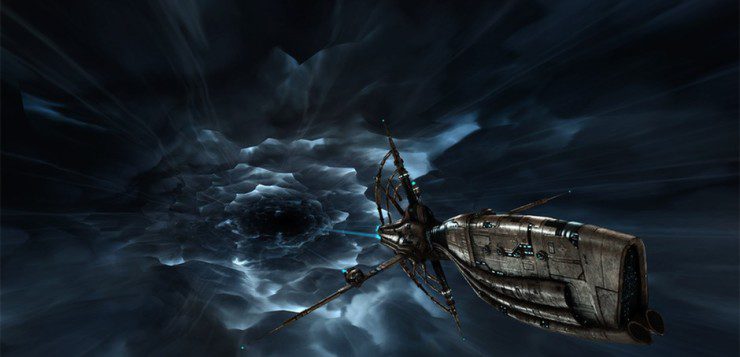
Being the innovator of the set, I will start with EvE Online. EvE has a form of offline training that has earned it the nickname “Skill Queue Online” on more than a few occasions. The reason for this name is that EvE’s primary form of advancement is, in fact, through skill training. On more than one occasion, I’ve read that once you have built up a decent enough stash of money and bought the necessities, skill books included, you are mostly relegated to logging in, queueing skills, and logging off. There are obvious exceptions to this, such as expanding your planetary dominion or taking part in PvP, most likely scheduled by your corporation, but the fact of the matter is that many have said over the years that, during intermediate periods of skill training when nothing is going on and you cannot yet use what you are training to be able to use, there is little reason to log in on a regular basis.
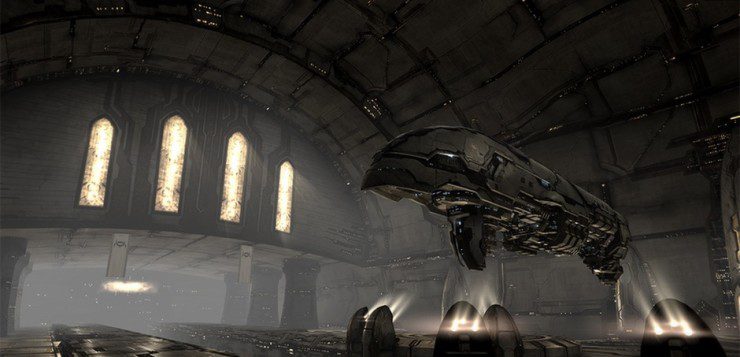
EvE’s form of offline training is one that grates on me. Skill books are relatively easy to obtain, leaving the skill queue to be your most obvious form of progression. While the mechanic makes sense, if only marginally, from a lore standpoint, this form of offline progression discourages active play unless you are going to be in a corporation that is constantly at war. Many argue that, due to constant ship loss, you will need to play often to keep a consistent stream of ISK coming in but I have also seen just as many argue that earning money is a lot easier than people realize. Of course, in the current era of EvE, selling PLEX, an in-game representing a month of subscription time, for ISK, EvE's form of currency, also discourages active play by taking away the need to play for money, as well.
As is probably evident by now, I personally think that EvE’s form of offline skill training causes more problems than it solves. Regardless of how long it takes or how often it does or does not occur, you will hit large stretches of time in which you feel no reason to play but maintain a subscription solely to queue up skills. Not only does this system not solve the issue of level gaps based on time played but actually worsens it by outright giving players that joined earlier an unreachable head start through tying skill training to real time. The end result is that the game takes a large part of control of your progress out of your hands and it can lead to feelings of getting nowhere fast, especially when these skills are all essentially just certificates that say “I’m ready to use this piece of gear.”
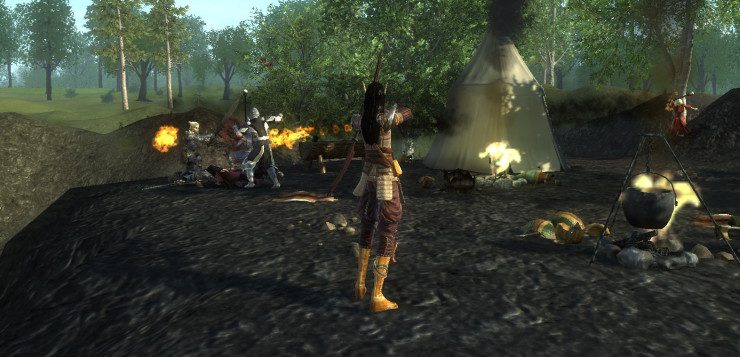
Pathfinder may be the newest of the games mentioned here but that makes its take on offline training that much more interesting. Foregoing training a specific skill, you character in Pathfinder accrues experience automatically for as long as you are subscribed. This experience can then be spent on active and passive skills at a skill trainer. At first, this may sound like the exact inverse of EvE, allowing you to stay offline indefinitely only to later buy your way to power with all of the experience you’ve accrued but there are limitations.
In lieu of traditional quests, Pathfinder has “achievements.” Some of these are simple, such as “kill five skeletons,” which scales up to “kill fifty skeletons,” and some are nebulously described as “reach Paladin level one.” These achievements limit your skill training progress. You must actually play the game and achieve specific goals to unlock specific skills.
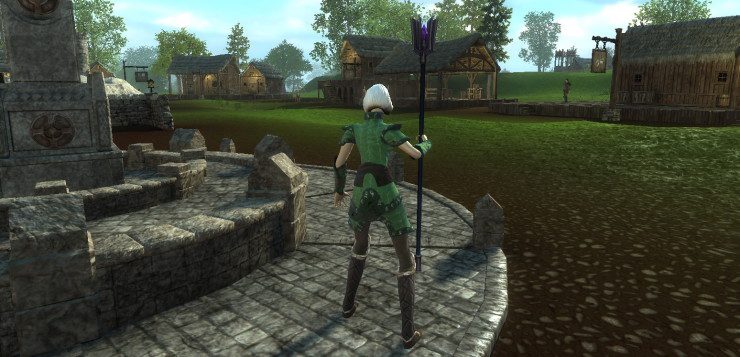
The problem is that, in creating a system that not only encourages, but requires, players to actually play the game, they have created a system that can become intensely grindy. Whereas EvE simply makes you wait absurd amounts of time for a single skill to train, Pathfinder makes you spend absurd amount of times on a single goal to unlock a skill or two. It is far from the perfect solution but you do at least feel a sense of actually accomplishing something when a new skill is unlocked. However, it also stunts progress if you reach a point where you are unlocking achievements before you earn the experience to buy the skills the achievement unlocked. This can lead to a sense of pointlessness, wondering what your training amounted to if you still have to wait a specific amount of time to be able to unlock the skill you were training for.
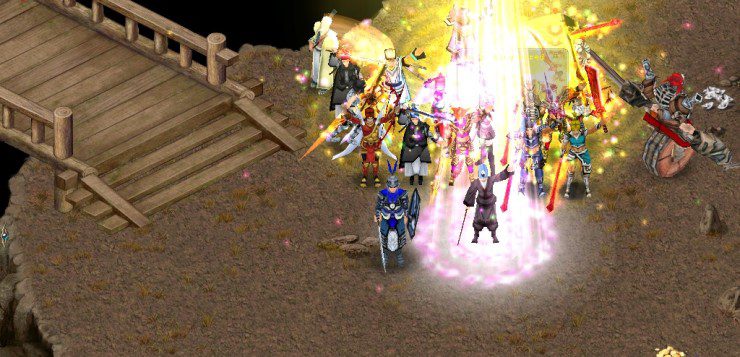
Conquer Online
Being more of a themepark grinder, Conquer Online is considerably different from those discussed so far. Predictably, its form of offline training is a bit different. Conquer’s form of offline skill training is an incredibly simple reward system where you earn ten minutes of offline training per minute you spend online. There is a fifteen hour per day cap to limit how much offline training takes place but, otherwise, you can build up as many minutes as you want.
This system is simply there to help you advance your character faster. The only reward for training while offline is more experience and, rather than provide a new set of mechanics that you have to manage, it complements the game’s core gameplay by allowing you to earn experience even when you can’t play. However, it also limits the amount of time you can spend in there, albeit a staggering fifteen hour limit, requiring you to play the game at some point regardless of how many offline training minutes you may have built up.

Alganon may be widely panned but it also has a unique form of offline training that doesn’t impede on the progression of the core game. Dubbed “Studies,” Alganon’s offline skill training takes place in parallel to a World of Warcraft-like themepark around it. Like EvE, you are required to buy or obtain Studies via a book or trainer and then queue them up to train in real time. Unlike EvE, these studies are not your only form of progression.
For the most part, Studies complement the main game rather than replace it. In real time, you will train slight statistical benefits, such as being sturdier or doing a bit more damage. Some Studies are solely to unlock specific quests. Simply put, they aren’t there to level or to directly influence your progression. You could progress—to a point—without spending a lot of time online but time spent playing the game is still required, as is customary for themepark MMOs.
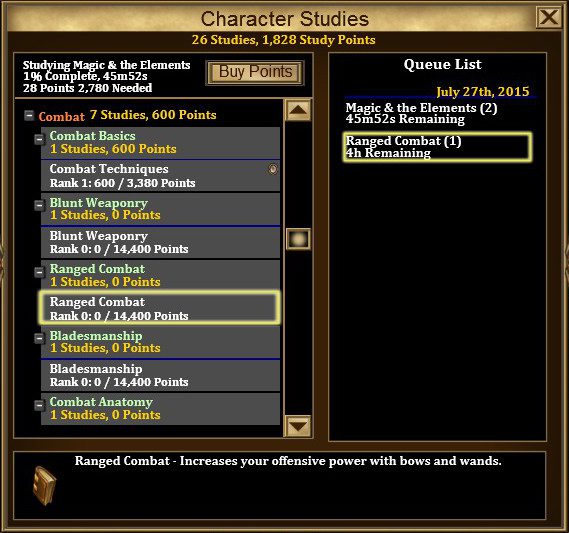
While this system is unique in that it runs in parallel to the core game rather than impeding progress in awkward manners, it still has a number of issues. Power is undoubtedly earned through Studies and endgame PvP could be determined by those who have been playing long enough to train specific power-heavy Studies to level five, an exact parallel to the problem facing the average gear grind, only without the need to play. This mentality is problematic, arguably even more so than the gear grind because players can’t close the gap simply by spending more time in-game. The only option is to wait out the weeks it takes to train these skills. Furthermore, in Alganon’s case, the gear grind is still very much an issue, amplifying the gap between veterans and players who have just recently reached the level cap.
Conclusions
While offline training sets out to help ease the gap between players by allowing them to advance regardless of the amount of time they have to play, there are still a number of core issues. Offline training is generally used to train skills or abilities that cannot be actively trained online and is often necessary, regardless of whether it is the absolute form of progression or purely supplementary. By placing progression in the hands of a system that runs in real time, offline training very obviously favors veterans, which is a bit disconcerting, considering that most games that employ the system are already incredibly niche. These games could be easily stunting their potential for growth based solely on the fact that it could take weeks, or even months, to advance what might be considered a single level in another game. Ultimately, the most prevalent question I have is: Why are games that appeal to hardcore, dedicated audiences the ones most commonly employing such hands-off systems of progression in the first place?

I've been playing MMOs since back in the day when my only option was to play Clan Lord on the family Mac. Since then, I've played too many MMOs to count. I generally play niche, sometimes even bizarre, MMOs and I've probably logged the most hours in Linkrealms prior to its current iteration. Currently bouncing between a few games.
