Chronicle: RuneScape Legends Beta Impressions

The concept of Chronicle: RuneScape Legends is one that I rather like. It’s a game in which you adventure to build up your character by playing cards on a board. It gives off a distinguished feel that exemplifies the RPG roots it has as a part of the RuneScape franchise, unlike many other card game spin-offs. In each game you’re going on an adventure through multiple landscapes, fighting enemies with cunning as well as brawn, and ultimately facing off against an opponent who has been doing the same.
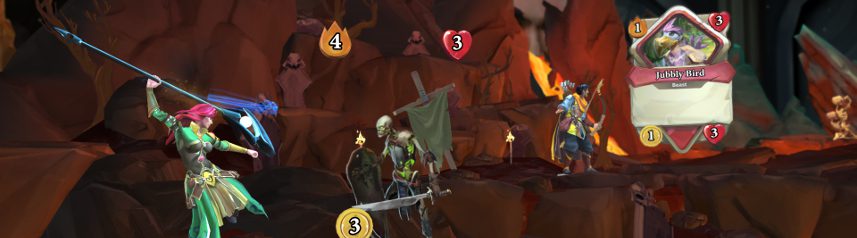
One of the first things I noticed when playing the game is that the board part of the game is purely visual. The boards are stylized well, with bright, appealing palettes. The one-frame animations that each piece has retain the board game feel even when action is happening. Make no mistake though, this is a card game that takes place on a board, rather than a board game that makes use of cards. Your character moves in linear, automated manner to represent a linear progression through several maps. It’s far less involved than I had hoped, despite being a nice touch.
[singlepic id=39832 w=768 h=432 float=none]
The game is divided into five chapters, each a unique map that allows you to place up to four cards. Once you have placed your four cards the game automatically works through each player’s cards one at a time. For example, if you won the coin flip at the beginning of the game it will play your first card, then your opponent’s first card, then you second card, and so on until that chapter is complete. Once the chapter is complete, the map you are on changes and each player draws three cards. This repeats until the end of the fifth chapter. If both players are still alive at the end of the fifth chapter they will trade blows—with the coin flip winner going first—until one player runs out of health. An entire game usually takes no longer than 15 minutes, making it ideal for quick sessions.
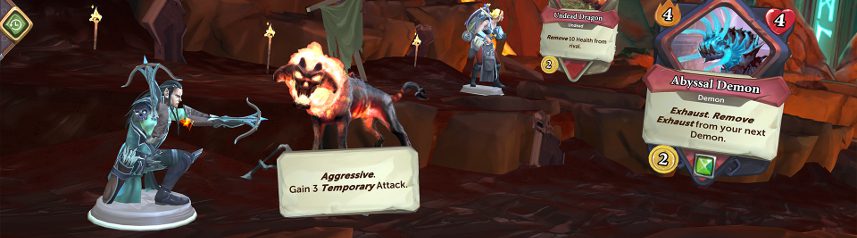
The cards you are given are broken up into two categories: Fight and Adventure. Fight cards are “mob cards” that provide various bonuses, such as gold or health. Occasionally, they have additional effects such as dealing damage to your opponent when defeated. Adventure cards are various cards that require a trade of some kind, but do not require combat with a mob. One may allow you to do damage to your opponent equal to half their gold. Another may allow you to gain health equivalent to the amount of armor you currently have. Usually, these cost only gold, but they may require a sacrifice of health or a weapon as an added cost.
[singlepic id=39829 w=768 h=432 float=none]
The cards are further split up based on your chosen hero. The majority of the game’s cards can be used by any of the four heroes, but smaller sets are reserved as hero-specific cards. A large part of your heavy-hitting cards will come from this set and victory will almost certainly hinge on preparing and executing a good strategy that makes use of these cards.
The wide variety of cards allows for a staggeringly large amount of strategies. Your strategy could be to build up armor and health to outlive your opponent at the end or it could be to sneakily undercut them by building up your gold reserves—or possibly theirs!—and hit them hard with an ability that does damage based on gold. Depending on how you play and which hero you use, you have a chance to be surprisingly underhanded. The heroes available currently represent an already varied set of core strategies that you can build on. These core strategies are mostly based on their MMORPG class equivalent. They may not be particularly diverse when compared to a game like Hearthstone—I imagine more are in the pipeline—but they each provide unique ways to approach victory.
As for the manner in which you obtain cards the Closed Beta provides three ways currently. You can buy a pack for 100 of a currency that you earn from completing dailies and winning games, you can earn a few from leveling each hero, or you can craft them using gems earned from playing the game. If you don’t have the right type of gem you can trade another type of gem for the type you need in what the game calls the “Open Exchange.”
[singlepic id=39831 w=768 h=432 float=none]
This is a solid base but there are a few issues. One of the more easily noticed issues is that of bad camera angles. Despite having only a few maps with predetermined camera locations, there are a times when you can’t see what is happening clearly. Other times, the camera can make it look as if your path and your opponent’s are one and the same. There are only a handful of cases like this, but it can be jarring nonetheless.
Another matter that I see as an issue may be something the team behind the game sees as a design choice. Certain cards are allowed to be used in ways that defeat their purpose entirely. The game generally tracks your current status incredibly well and will even disable certain cards for that slot if the current progression of cards will end up killing you. This is not true for all cards. For example, one card allows you to lose your weapon in exchange for granting you three gold. You can use this card if you do not have a weapon, essentially generating free money with no trade-off. Happened to draw this card at the start? Play it instantly for a free three gold. Have a weapon? No problem. Plan to use this card right after the durability on your weapon runs out. There are other examples but this is by far the worst offender.
Furthermore, the starting experience could use some work. Given that they are permanent staples of your collection, you would assume that each starter deck is created equal. Unfortunately, they are not, with some decks being significantly more comfortable to play than others. I will use Ozan’s deck and Ariane’s deck as examples.
[singlepic id=39832 w=768 h=432 float=none]
Ozan is more of a rogue-type character and, as such, his deck is focused on being a lot more underhanded. His character-specific starter cards include one that does your weapon’s damage plus one to your opponent’s health, one that sacrifices half of your gold to do half of your gold’s worth of damage to your opponent, one that does damage equal to half of your opponent’s gold to them, and one that allows you to gain four gold in exchange for giving your rival two gold. The problem with this is that in order to take advantage of the weapon damage card you must spend a lot of gold. In order to make use of the card that does damage based on your gold, you must save a lot of gold. In order to make use of the card that does damage based on your opponent’s gold you must hope that your opponent isn’t constantly spending their own gold. Considering that a popular strategy is to buy a weapon and use it to strike your opponent before the durability runs out, the chances of your opponent saving a large enough amount of gold to make a decent strike are low. With that eliminated as an option you are left with two core strategies that conflict with each other and the hope that you draw the right cards to pull off the one you are attempting. There is a later card that eases the conflict between those two strategies by lowering the cost of your next support card by four, but you will not have this at the beginning and I can easily see players that choose Ozan becoming frustrated with his starter deck and giving up. Surviving until the final showdown was rare. Defeating an opponent before the final showdown was even rarer.
[singlepic id=39830 w=768 h=432 float=none]
Ariane’s deck, on the other hand, has a much better set of cards. Ariane’s character-specific cards include one that allows you to take three of your opponent’s health points at no cost, one that allows you to lose two health and one gold to draw five cards, and one that allows you to deal damage to your opponent equal to twice the amount of cards in your hand for the cost of eight gold. Ariane also has some character-specific monsters that allow her to gain three attack for the next card or deal five damage to your opponent once you have defeated them. The damage dealing card also grants gold. Played with relatively little effort, a player using Ariane’s starter deck could easily chip away at their opponent’s health while stocking up gold and then deal a killing blow to the tune of 16 damage or more by the third chapter. This is personally what I did the very first time that I played using Ariane’s starter deck. Strikes of that caliber simply aren’t possible with Ozan in the average game. You would be lucky if you could manage a combined 16 damage from both a gold-based damage card and the weapon damage plus one card. The highest I have ever seen another player’s gold reach is 22 and it did little to help me win at the time.
[singlepic id=39828 w=768 h=432 float=none]
Chronicle: RuneScape Legends is an interesting idea. It’s presented well and I think the overall design is quite great. I've never personally played a card game that felt this much like a short-session RPG. There are just a few small issues with balance and minute details of the game’s implementation that are currently holding it back. Later in the game, I imagine that the balance issues sort themselves out as you craft better decks, but the early game is just as important to keep balanced. However, much like Hi-Rez is doing with Paladins, Jagex is calling Chronicle’s current testing phase a “real beta,” meaning that real change could come from it. The game has promise and, with any luck, Jagex will capitalize upon it.
Related:


I've been playing MMOs since back in the day when my only option was to play Clan Lord on the family Mac. Since then, I've played too many MMOs to count. I generally play niche, sometimes even bizarre, MMOs and I've probably logged the most hours in Linkrealms prior to its current iteration. Currently bouncing between a few games.
